

About me
I am a statistical consultant working within both industry and academics to deliver cutting-edge analyses and scientific reports in a wide array of application domains. During my academic career, I transitioned between multiple institutions, taught and developed a wide variety of courses at the bachelor and master’s level, as well as conducted research in disparate fields. Since leaving academics, I have supported applied researchers throughout their publication process, either in selecting appropriate methodology, performing advanced analyses, verifying results using robust tools, or writing technical appendices. Additionally, I have supported companies in the construction of statistical, machine learning, and AI tools, which greatly improved the performance of their predictions and usefulness of their inferences.
My experiences have culminated in a diverse skill set that has been tuned to rigorously analyze new problems and improve upon state-of-the-art methods in multiple domains. I enjoy the translation of applied problems to concrete statistical tasks and am always eager to explore new methods and applications. This translation is what separates the naive application of statistical and machine learning techniques from the insights that they are able to generate. I bring this perspective to the classroom when I teach at the University of Vienna and Medical University of Vienna.
“Thank you sincerely for your excellent work, continuous support, and patience. I enjoyed working with you and will recommend your services to others.”
— Prof. Ella Miron-Spektor, INSEAD
“The technical depth and clarity of the manuscript is outstanding! This is one of the best COVID modeling papers I have read in terms of technical depth and clarity.”
— Anonymous Reviewer, PLOS Global Public Health
“This is perfect, thank you! … [This is] very helpful! To the point where we want to keep digging since it triggered lots of follow up questions.”
— Kristina Lee, Shelterluv Director of Business Operations
My Work
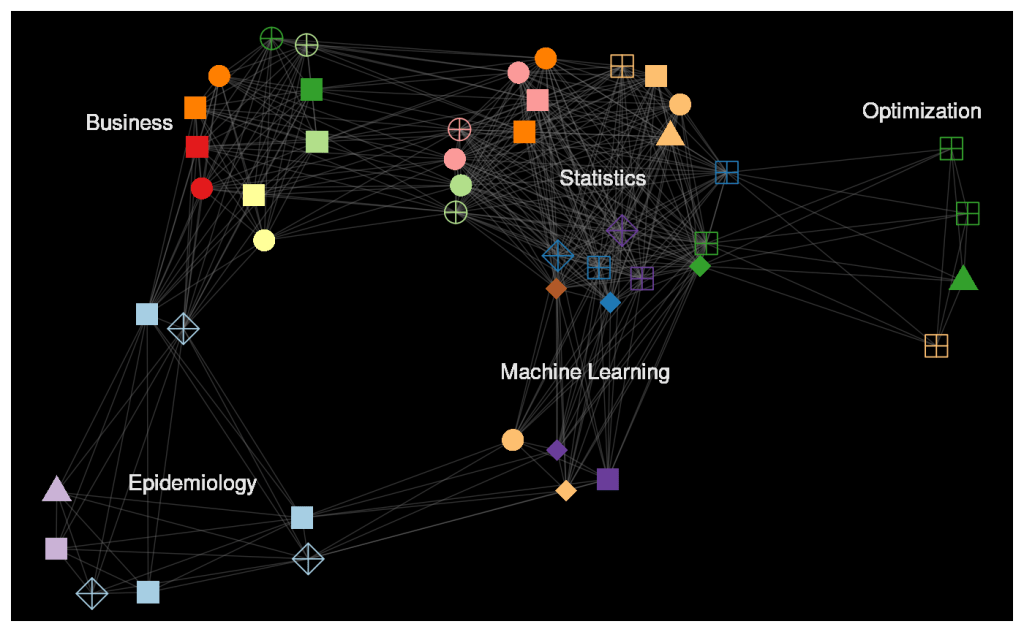
I have spent many years surrounded by statistical problems in diverse fields, and I have both used and taught a diverse array of tools to solve them. This includes classical, nonparametric, and Bayesian statistics as well as optimization, machine learning, and neural networks. My projects have analyzed cross-sectional, time series, and multilevel data. This network image condenses and displays the diversity of my work. Each node represents an analysis while their color corresponds to a class of method used and shape to a style of analysis (theory, methodology, modeling, etc). Edges connecting analyses link them by field. As an additional visual guide, some labels are provided to node groupings.
My areas of expertise include linear models (including interaction models), generalized linear models (logistic, Poisson, negative binomial, zero-inflated Poisson etc), nonparametric regression, random forests, ensemble learning, Bayesian hierarchical modeling, multilevel modeling (fixed/random-effect modeling), inference (parametric, non-parametric, and bootstrap methodologies), multiple comparisons, repeated testing, clinical trials, forecasting, structural equation modeling, path analysis, factor analysis, cluster analysis, design of experiments, survey design, etc.
Every project I have and course I teach is an opportunity to learn some new nuance or feature of these methodologies. I welcome projects outside of these areas, and, as I have done before, will allot the time to gain expertise in a new subfield. While less flashy than the above, data cleaning, exploratory data analysis, and data visualization are all integral parts of data science. I thoroughly enjoy this process and almost always discover further details of interest to researchers.
The Process
1.
Introduction
Brief, no-commitment call to discuss the data setting, goals of the analysis, and potential statistical methods employed.
2.
Exploration
“In theory there is no difference between theory and practice; in practice there is.” – Various Authors
A preliminary, exploratory data analysis is necessary on large projects to properly determine the scope and deliverables.
3.
Work Order
Only now do we settle the task and timeline, keeping in mind that you may only need help with a single step of the process and then will progress the project independently until a point at which my services would again be useful.
4.
Delivery & Review
Physical deliverables including all code, images, and statistical descriptions will be presented during an online or in-person meeting. Steps 3 & 4 can be iterated as necessary.
 Kory D. Johnson